

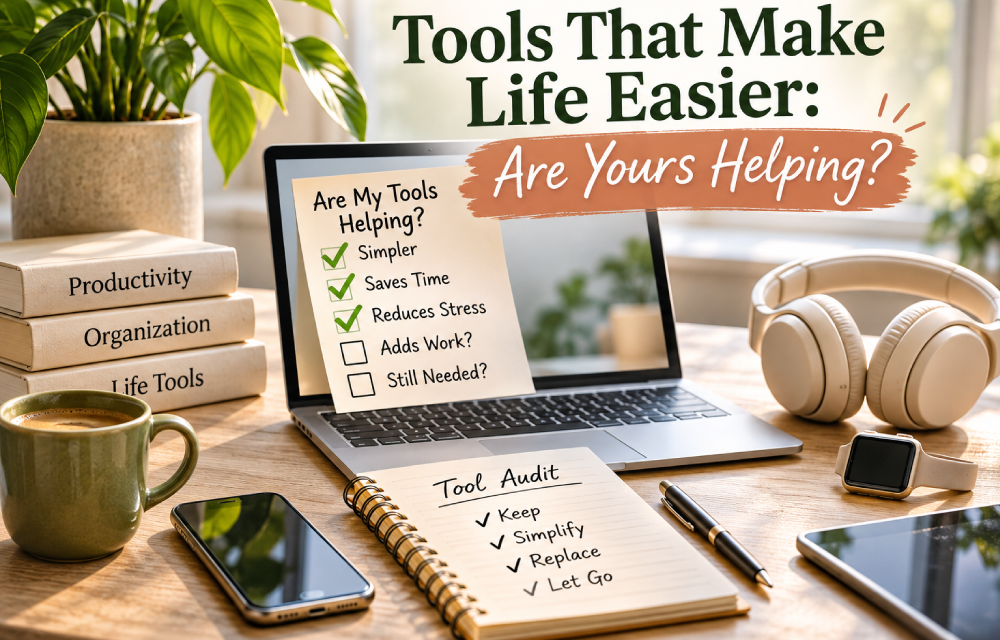
Your Tools Should Make Life Easier. Are They?
The apps, gadgets, and systems we rely on are supposed to simplify our lives. But what happens when managing them becomes another responsibility?
We live in a world filled with tools that make life easier—or at least promise to.
There are apps to organize our schedules, devices to automate our homes, platforms to manage our finances, and systems to help us remember everything from grocery lists to important appointments.
Whatever the problem, there’s probably a tool promising to solve it.
And often, these tools genuinely help.
But somewhere between downloading another app, purchasing another gadget, and subscribing to another service, it’s worth asking a simple question:
Are the tools we’re using actually making our lives easier?
Because there’s a difference between having access to something useful and experiencing the benefits of using it.
Sometimes, the tools we bring into our lives to reduce effort end up requiring more of it.
When Tools That Make Life Easier Become Complicated
Think about the last time you downloaded an app because you wanted to become more organized. Maybe it was a task manager, a budgeting app, or a digital planner.
Initially, the possibilities seemed exciting. You imagined having everything in one place, remembering important tasks, and finally feeling on top of your responsibilities.
Then came the setup. You created categories, customized settings, entered information, connected accounts, and watched a few tutorials.
A few days later, you discovered features you hadn’t explored. Perhaps there were notifications to adjust, integrations to configure, or a more efficient way to organize everything.
Before long, the system you created to manage your responsibilities had become another responsibility. This doesn’t mean the app was poorly designed or that you were using it incorrectly.
It simply means the tools that make life easier should reduce the effort involved in everyday tasks, not create additional responsibilities. Convenience isn’t determined by what a tool can do. It’s determined by how much easier it makes your actual life.
A sophisticated system may work beautifully for someone managing a large team but feel unnecessarily complicated for someone who simply wants to remember three important things each day. The same principle applies beyond technology.
A kitchen gadget that requires extensive cleaning may not save much time. A home organization system with dozens of containers may create more maintenance than the clutter it was intended to solve.
Even a subscription service designed to simplify shopping can become another expense to monitor.
The question isn’t whether these tools are useful.
It’s whether they’re useful enough to justify what they require from us.
The Hidden Cost of a Helpful Tool
When evaluating tools that make life easier, we tend to focus on their purchase price or subscription fee. But money is only part of the cost. Every tool requires something from us, even when that requirement isn’t immediately obvious.
The time it takes to learn
Some tools are intuitive. Others require tutorials, experimentation, and repeated adjustments before they become useful. Learning something new isn’t inherently a problem. The question is whether the time invested produces a meaningful benefit.
Spending two hours learning a system that saves you several hours every week may be worthwhile.
Spending two hours configuring an app you rarely open probably isn’t.
The attention it demands
Notifications, reminders, updates, alerts, and dashboards all compete for our attention. A tool designed to keep us informed can unintentionally create a constant sense that something requires our response.
Consider a smart device that sends notifications every time it detects movement, or a productivity app that reminds you repeatedly about unfinished tasks.
These features may be useful in the right circumstances. But when every tool demands attention, convenience can begin to feel like interruption.
The maintenance it requires
Tools rarely remain useful without some level of upkeep. Software needs updating. Devices need charging. Organizational systems need maintaining. Subscriptions need reviewing. The Federal Trade Commission’s guidance on subscriptions and automatic renewals offers practical advice for keeping track of recurring charges and avoiding unnecessary expenses.
Individually, these responsibilities may seem insignificant. Collectively, they can become another layer of constant upkeep.
The mental space it occupies
There’s also the less visible cost of remembering which tool does what. You might have one app for appointments, another for tasks, a third for notes, and a fourth for tracking habits. Each may work well individually, but managing them together can add to your mental overload. As we explored in The Exhaustion You Can’t Fix With Sleep, sometimes it’s the accumulation of everyday demands—not physical activity—that leaves us feeling depleted.
A tool’s real cost includes the effort required to keep using it. That doesn’t automatically make it a bad investment. It simply means the benefits should be worth the ongoing commitment.
Not All Tools That Make Life Easier Are Necessary
One of the easiest mistakes to make is assuming that because something is useful, we need it. A new app may have excellent reviews. A kitchen appliance may perform its function beautifully. An organizational product may solve a problem for thousands of people. None of that guarantees it belongs in your life.
Consider a person who enjoys cooking and regularly prepares meals for a large family. A food processor may save considerable time. For someone who cooks occasionally and prepares simple meals, that same appliance might spend most of its life occupying valuable cabinet space.
Neither person is right or wrong. Their needs are simply different.
Technology creates similar situations. Someone managing multiple projects with deadlines and collaborators may benefit from a comprehensive project management platform. Someone managing a handful of personal responsibilities may find a basic calendar and notebook more than sufficient.
Yet, we’re frequently encouraged to upgrade, optimize, and adopt new systems simply because better options exist. This pressure isn’t limited to technology. As discussed in The Hidden Cost of Self-Improvement, the constant pursuit of becoming better can sometimes create more pressure than progress. The same principle applies to our tools: upgrading something that’s already working doesn’t automatically improve our lives.
Start with the problem, not the product. That one distinction can prevent unnecessary purchases, subscriptions, and complicated systems.
Are You Managing Your Tools, or Are They Managing You?
Most of us don’t deliberately choose to complicate our lives. It’s usually happens gradually. Consider these scenarios:
- We add something to solve a problem, then introduce something else to manage the first solution.
- Creating reminders to check our reminders.
- Purchase organizational products to organize the organizational products we already own.
- We maintain subscriptions because we might need them someday.
Over time, these recurring expenses can become easy to overlook, especially when they’re spread across multiple services. AARP offers practical tips for managing and canceling unwanted subscriptions, including reviewing charges and identifying services that no longer provide meaningful value.
Here are a few signs that a tool may be creating more work than it’s eliminating:
- You spend more time organizing the tool than completing the task it was meant to support.
- You frequently duplicate information across multiple apps or systems.
- You continue paying for features or services you rarely use.
- You feel obligated to use something simply because you’ve already invested money or time in it.
- You avoid a task because the system you’ve created around it feels overwhelming.
- You could accomplish the same result more easily with something you already own.
None of these automatically means you should abandon a tool. Sometimes the solution is as simple as turning off unnecessary notifications, removing unused features, or changing how frequently you interact with it.
Other times, the tool may no longer serve the purpose for which you originally chose it. And that’s worth recognizing.
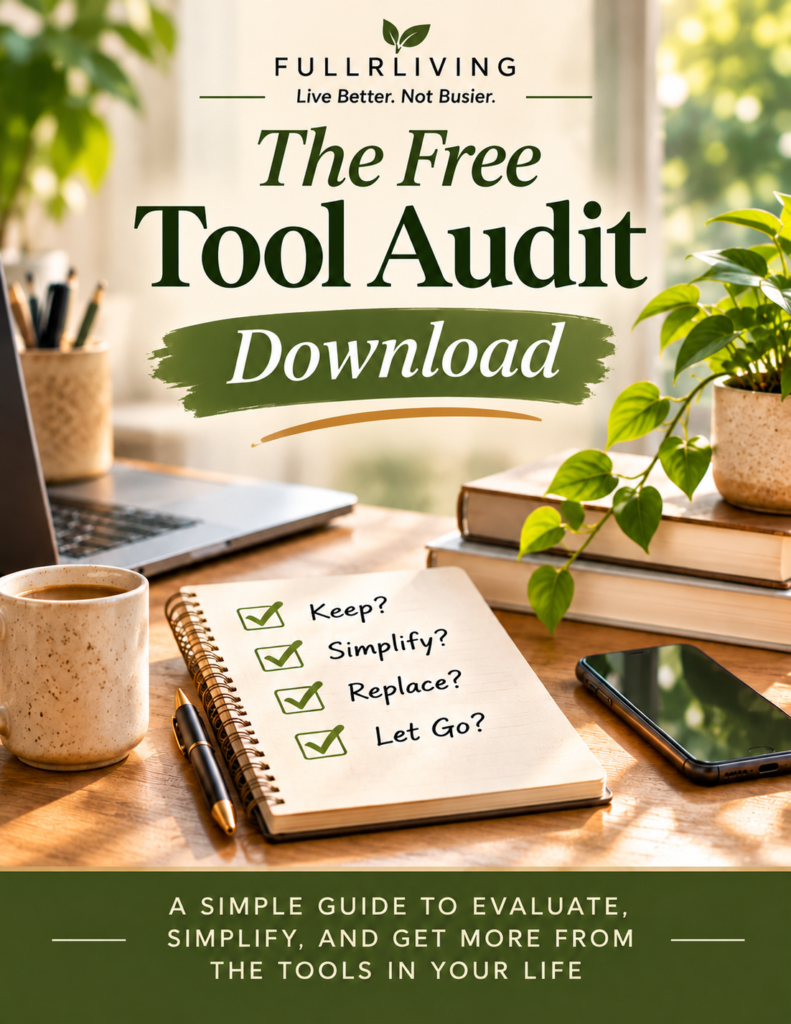 The Simplicity Test: Five Questions Worth Asking
Finding tools that make life easier begins with understanding whether the ones you already own are actually helping. You don’t need to evaluate every app, gadget, or system. Start with one that has been frustrating you, one you rarely use, or one you’re unsure is worth keeping. Then ask yourself five questions.
1. What problem was this tool supposed to solve?
Be specific. Instead of saying, “I wanted to be more organized,” identify the actual problem. Perhaps you were forgetting appointments, spending too much time planning meals, or struggling to keep track of household expenses. A clearly defined problem makes it easier to determine whether a tool is helping.
2. Is it actually solving a problem?
Think about your experience rather than the features advertised.
- Are you forgetting fewer appointments?
- Spending less time on repetitive tasks?
- Has managing your money become clearer?
If the original problem remains unchanged, the tool may need adjusting, replacing, or reconsidering.
3. How much time, money, or attention does it require?
Consider your full commitment. Include subscription costs, maintenance, setup, learning time, and the mental effort involved in using it.
Then compare those costs with the benefits you’re receiving. You may discover that a tool requiring considerable effort is still worthwhile. Or you may realize you’re investing more than you’re gaining.
4. Would my life become harder if I stopped using it?
This question can be surprisingly revealing. If you stopped using the tool tomorrow, what would actually happen?
- Would an important responsibility become more difficult?
- Likely to lose a convenience you genuinely value?
- Or would very little change?
Sometimes we continue using tools because they’ve become familiar, not because they’re essential.
5. Is there a simpler way to achieve the same result?
This doesn’t necessarily mean purchasing something new. Perhaps you can use fewer features, combine two systems, return to something you already own, or eliminate an unnecessary step entirely.
The goal isn’t to find the most basic solution. It’s to find the solution that works with the least unnecessary friction.
Before You Choose More Tools That Make Life Easier
The next time you discover an app, device, or organizational system that promises to improve your life, consider waiting before adopting it. Ask yourself what problem you’re experiencing right now.
- Is it significant enough to require a new solution?
- Have you already tried using what you own?
- Will this new tool reduce the effort involved, or simply change where that effort goes?
There’s nothing wrong with enjoying technology, experimenting with new products, or investing in things that improve your daily experience. The purpose isn’t to avoid tools, it’s to become more intentional about choosing them.
Because a genuinely helpful tool should support the life you’re living, not require you to reorganize your life around it.
Choose What Earns Its Place
Choosing tools that make life easier doesn’t necessarily mean getting rid of everything that requires effort. Once you’ve evaluated a tool, you have several reasonable options.
Keep it. If it consistently makes something easier and the benefits outweigh the effort, it has earned its place.
Simplify it. Perhaps you don’t need every feature, notification, or integration. Sometimes reducing how you use a tool makes it more effective.
Replace it. If something is unnecessarily complicated, a simpler alternative may serve you better.
Let it go. If a tool no longer solves a meaningful problem, you don’t have to keep using it because you once believed it would help.
There’s no need to make these decisions at once. In fact, constantly searching for better tools can become its own exhausting project.
Instead, approach the process gradually. Choose one tool that’s creating friction. Evaluate it. Make one adjustment. Then notice whether everyday life becomes a little easier.
That’s enough to begin.
Final Thought: Less Managing. More Living.
Tools are meant to serve a purpose. They help us accomplish tasks, solve problems, reduce effort, and make room for other things that matter. But their value isn’t measured by how advanced they are, how many features they offer, or how popular they’ve become.
The best tools that make life easier are the ones that genuinely reduce effort, solve meaningful problems, and support the way you live. Their value is measured by what they make possible in our everyday lives.
- Sometimes that means embracing a new technology.
- Simplifying an existing system.
- Recognizing that we don’t need another tool at all.
The goal isn’t to have the best collection of tools. It’s to have the right ones for your life. After all, living better shouldn’t require managing more.
Fullrliving — Live Better. Not Busier.